miercuri, 22 iunie 2011

Peugeot 207 CC 1.6 VTI GT (2011)


The Peugeot 207 CC is the survivor of the supermini hardtop convertible class. Whilst the Daihatsu Copen, Nissan Micra C+C and Vauxhall Tigra have left new car price lists, the 207 has continued in production, selling almost 148,000 units worldwide between 2007 and 2010.


In the meantime the funsize convertible market has welcomed a pair of retro rivals (the Mini Convertible and the Fiat 500C) and the flip-top Renault Wind. Is the 207 CC still a viable competitor in the small convertible class? Read on for our first drive review of the Peugeot 207 CC to find out...
The 207 CC comes in Sport or GT trim levels, with the choice of three engines. A 120bhp 1.6-litre four cylinder petrol, a 150bhp turbocharged version of the petrol engine, or a 110bhp 1.6-litre turbodiesel. Our car matched the basic engine in five-speed manual form (a four-speed automatic is optional) with upscale GT trim. That meant 17-inch wheels, dual-zone climate control air conditioning, leather-covered wheel rim and shift knob, folding mirrors and parking sensors as standard on the 207 CC GT.


With the 120bhp non-turbo 1.6-litre petrol engine it's fair to say the 207 CC lacked vigour. A Mini Cooper Convertible with similar powerplant carries around 200kg less weight and gets up to speed with greater urgency. It's best to ignore the sporty pretence of those drilled aluminium pedals and white-faced dials, relax and cruise.
Lightness pervades the Peugeot's steering, shift and pedals but the car handles accurately and has no shortage of roadholding on its 17-inch wheels and tyres. It rides well and beyond some mild wind-whistle around the frameless side windows roof-up, the main noise issue comes from a lack of a sixth gear for motorway work. There is little noticable deterioration in the car's handling ability while driving in open-air mode.


  • How much? £18,045.
  • Engine: 1598cc 16v four-cylinder, 120bhp @ 6000rpm, 120lb ft @ 4250rpm.
  • Transmission: Five-speed manual, front-wheel drive.
  • Performance: 10.7 sec 0-62, 124mph, 43.5 mpg, 150g/km.

luni, 20 iunie 2011

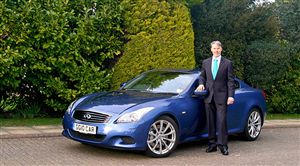
Infiniti G37S Coupe (2010)


There was a real sense of loss as I watched the G Coupé being trailered away this month. It was a car that endeared itself with every passing mile, one brimful of character and confidence. It was an unusual day if I wasn’t asked about the Infiniti – who made it, how much it cost and what it was like to drive were the commonest questions – and it was a car that made me feel special, something arguably far more important than top speed, fuel economy, purchase price or any other criterion used to judge a car.


The Infiniti enjoyed its drink – the G gorged itself on the best part of 1300 litres of unleaded during its six-month stay, returning around 21.6mpg. But I never begrudged the £90 weekly fuel bill because burning every drop of petrol was a delight. The grunty 316bhp 3.7-litre V6 was quite happy to amble along around town and burble around country roads but it was at its aural and dynamic best hammering up against its 7500rpm redline, the powerhouse slingshotting the coupé along with license-loosing addiction.
Although its on-paper stats of 265 lb ft at 5200rpm make it sound peaky, the all-alloy unit was anything but. As soon as it was above 2500rpm it rocketed along in any gear, an appetite for pace matched by the taut suspension, wrist flick four-wheel steering and agile tail-happy chassis. Flinging this car hard and fast along well-known roads was magic.
The seven-speed automatic gearbox was the dynamic weak point in what was otherwise a polished and driver-centric package. Although the paddle-shifter was a learner, it just never seemed to deliver the requisite gearshift quality when it was needed. I got slushy when I wanted crisp, jerky when I wanted smooth and ponderous when I wanted quick. Note to those Infiniti engineers working on the next-gen G – an eight-speed double clutcher next time round, please. And make sure it and the engine fully understand each other.


I loved the G’s cabin. More flamboyant than anything from Germany, it combined a superb ergonomic layout with extravagant levels of standard luxury, safety and infotainment equipment. There wasn’t a great deal of room in the back, but my two young daughters didn’t mind, enjoying the Infiniti’s acceleration and sense of drama instead. 
The intuitive Connectiviti+ satnav, stunning Bose audio set-up, excellent chairs, active bi-Xenon headlights and smart cruise control all deserve a special mention. They were quite brilliant, as appealing as the car’s design. Although it had its detractors, I thought the G looked just the way a powerful and opulent coupé should – muscular, elegant and distinctive. That it made a highlight of its Japanese origins, rather than try and mimic its European rivals heightened its appeal.
As did the people behind it. Whenever I spoke to Infiniti global boss Andy Palmer, European head honcho Jim Wright or chief designer Shiro Nakamura, I was always struck by how they talked about Infiniti’s success in emotional rather than statistical terms.


Don't get me wrong, the company has a huge challenge ahead of it – one made even harder by the current economic climate and the recent devastating earthquake in Japan – but Wright and Palmer know just how hard fought success will be. Hence the modest sales aspiration and equally pragmatic levels or market penetration. As Palmer told me at Geneva, “It will be tough, but I am extremely ambitious about Infiniti. Its time is now.” Having spent a hugely rewarding six months in his company’s performance flagship, I wholeheartedly agree with him.

Toyota Yaris (2011)


Toyota has issued these first pictures of its new Yaris supermini. It's the third-generation Toyota Yaris and seems to mix some of the Vauxhall Corsa creases with the proportions of a Renault Clio.
It's a pert, very Euro piece of design, neatly incorporating the latest Toyota motifs - and you can judge for yourself when it goes on sale here in summer 2011.
They're not saying much about the new Yaris yet, but Toyota promises it is surprisingly roomy inside despite its compact footprint.
Toyota will play catch-up with arch rival Honda when the new Yaris Hybrid arrives in 2012 to compete with the Jazz Hybrid. At launch, UK buyers will pick from the following three engines:
• 1.0-litre VVT-i petrol.
• 1.3-litre dual VVT-i petrol.
• 1.4-litre D-4D diesel.

Toyota will launch its take on the multimedia touchscreens you'll normally find in Jaguars, Land Rovers and Volkswagen group products. Toyota says 95% of Yaris minis will come equipped with the 6.5in Touch & Go system to govern entertainment and nav systems.

Judging by this cabin photo inside the new 2011 Yaris, the touchscreen protects the dashboard from button overload.

duminică, 19 iunie 2011

Renaultsport Megane 265 Trophy (2011)


Renaultsport fanatics rejoice! Renault have dusted-off the Trophy nameplate for the new Renaultsport Megane 265 Trophy, a 500-unit limited edition model. Set to debut at the World Series by Renault race at the Nurburgring on 18-19 June 2011, the Megane 265 Trophy has been developed to take on hot-hatch rivals including VW Group's Scirocco R and Golf R.


The 2011 Renaultsport Megane 265 Trophy gets a series of engine mods, including a rise in turbo boost pressure from 2.0 to 2.5 bar, and a revised intake. The result is a power kick to 261bhp, from the standard Megane 250's 247bhp. Torque rises to 266 lb/ft, making it the most powerful RS Megane ever. The tweaked engine shaves 0.1 sec off the 0-62mph time (now 6.0 seconds) and top speed goes from 'ou revoir UK license' 156mph to 'yes it's the 265 Trophy, officer' 158mph. The Megane 265 Trophy is officially Renaultsports's fastest ever car.


Helping the RS Megane 265 Trophy's torque-steer limiting front struts and limited slip differential put the power to the ground are a set of Bridgestone Potenza RE 050 tyres wrapped around 19-inch Speedline alloy wheels in brake dust obscuring black. The other exterior clues to this special edition are the red Trophy decals on the doors and front air intake, and LED daytime running lights.

Inside, you'll find standard-fit Recaro bucket seats, Renaultsport yellow seatbelts and trim stitching and the Renaultsport Monitor onboard computer for performance data. Lastly there is the all-important numbered plaque denoting your limited edition status. Just like a Megane Coupe Monaco GP edition, but for people who do trackdays.


Speaking of which, your purchase of a RS 265 Trophy grants you a year's worth of Renaultsport trackday participation in 2012, valued at £650. The perfect environment to test the expanded performance of the new 265 Trophy.

sâmbătă, 18 iunie 2011

Rolls-Royce 102 EX (2011)


This is the Rolls-Royce 102EX. Also known as the Phantom Experimental Electric, it swaps V12 petrol power for a massive block of batteries and electric motors to create perhaps the least-likely EV conversion ever.
Does the Rolls-Royce 102EX work as a viable EV luxury limo? Read on for CAR's drive of the 102EX to find out...

It’s worth starting with the question of why Rolls-Royce is building an electric car. This is not, the firm is very keen to stress, a ‘green’ concept. This is not about environmental sustainability. It’s far more important than that: it’s about the sustainability of Rolls-Royce as a business. Its customers don’t ask it for more environmentally-acceptable cars. It’s not that they don’t care. If they want a Tesla or a Leaf or a Prius they’ll just buy one; they don’t look to Rolls-Royce for green solutions, and as one of a fleet of cars don’t drive their Phantom or Ghost far or often enough to be bothered by its consumption.


But this is a problem for Rolls-Royce, which knows that one day the oil will run out, and that it needs to be ready with an alternative to petrol V12s that its customers find acceptable. You’d have thought that near-silent, vibration-free electric motors that deliver all their huge torque instantly would be ideal; in the quest for perfect refinement, imagine being able to take the noise, vibration and harshness of an internal combustion engine (even a silky Rolls V12) out of the equation altogether. But a Rolls-Royce is more than a luxury good; it’s meant to be a supreme piece of engineering too, and the firm is remarkably candid about being unsure how important an actual engine is to its reputation for engineering. That’s why it has built the 102EX. And it seems quite prepared for its customers to hate it.


And then there’s the range problem - 125 miles in the 102EX. It’s actually less of a problem in a Rolls-Royce than almost anything else. They do lower mileages than other cars; they’re typically used to move around city centres, or go from town to the airport or a suburban home. Nobody runs a Rolls-Royce as their only car; buy an electric Phantom and you’ll have another car (probably another Rolls) for trips longer than the battery can manage. And because a Rolls-Royce is already so furiously expensive, the cost of the battery, which usually distorts the price and economics of ordinary electric cars, is much less significant, and Rolls can simply fit the biggest the car will take.

Mercedes S63 AMG (2011)


The Mercedes S63 AMG has received the latest 5.5-litre twin-turbocharged V8 engine. In AMG terms that counts as a notable case of downsizing, replacing as it does the 6.3-litre naturally-aspirated V8 in the AMG line-up. But how does the smaller V8 affect the driving experience in AMG's hi-po limo?
Apparently popping two fives on the boot of the new 5.5-litre AMG S-Class would be a 'retrospective step', so the '63' badge remains. The engine swap alters the S63 significantly though. If you actually care what your £109,125 luxury sledgehammer saloon consumes it achieves 26.9mpg and 244g/km - helped by a start-stop system. Impressive, given the S63’s ample 536bhp and 590lb.ft of torque.
Spend a further £7,890 on the Performance Pack and an increase in boost from the 5.5-litre’s two turbos raises those numbers to 563bhp and 664lb.ft, dropping the 0-62mph time from 4.5- to 4.4 seconds. The speed limiter is raised from 155- to 186mph too.
The new S63 is an altogether more enjoyable driving experience than its rather incongruous, high-revving 6.2-litre V8 predecessor. With seven gears and peak torque available from 2,000-4,500rpm the S63 is effortlessly fast all the time - in the manner big luxury cars should be. Wring it out and it’s a maniac, a sort of Dr Jekyll and fine hides, with a rich cultured soundtrack in accompaniment.
AMG's tweaking of the Active Body Control imbues the big S-Class with agility combined with real comfort, though the S63’s size and lifeless steering eventually curb your enthusiasm. Nonetheless, the S63 handles remarkably well for a car of its generous proportions.

New safety kit debuts on the S63 too, with Lane Keeping Assist and Blindspot Assist intervening and braking individual wheels to keep you on course. It all adds up to a thoroughly accomplished autobahn-stormer. Just don't think too much about the bloke in the S350 CDI, who might not keep up with you in the fast lane, but will sail on by while you're stopped at the service station refueling your S63. The 26.9mpg claim requires resisting the temptation of that twin-turbo V8 to achieve.


  • How much? £112,290.
  • Engine: 5461cc V8 bi-turbo, 536bhp @ 5,500rpm, 590lb ft @ 2,000-4500rpm.
  • Transmission: Seven-speed AMG MCT Speedshift, rear-wheel drive.
  • Performance: 4.5 sec 0-62mph, top speed 155 mph (limited), 26.9mpg, 244g/km.

Porsche Panamera V6 (2011)


Porsche's Panamera is the entry-level model in Porsche's five-door GT range. Fitted with a 3.6-litre V6 engine, the basic Panamera begs a significant question: without the massive performance or four-wheel drive, does the Panamera's four-seater practicality overwhelm the controversial looks?
Read on for out test of the Porsche Panamera V6 to find out...


One week, two very different drives in the entry level Panamera V6. The first was a night away with the wife and two-year-old, the second a quick blast over a favourite road.
Load the family aboard and you’ll need to squeeze their belongings in the undersized boot like you’re overwhelming a sandwich toaster, and the rear seats – just the four seats total in a Panamera – are a little less spacious than you might expect.
At least the seats are comfortable, and the fit and finish impeccable. It’s a lovely place to be. Adopt a chauffeur-like attitude to family ferrying and the V6 works incredibly well.


Road- and wind-noise is near non-existent, the ride firm if perfectly acceptable, the PDK gearbox (an option) incredibly smooth and the V6 refined, its 296bhp perfectly up to the job.
Drive it harder and you notice the V6 becoming breathy and feeling overworked, while the dual-clutch gearbox’s façade occasionally falters – it can thunk when you floor it at very low speeds, and takes too long to jump from seventh to, say, third when you need to overtake.
I remember the rear-drive V8’s auto feeling smoother, more decisive. But the steering is excellent, the body well controlled, the chassis agile – and, at 1730kg, it’s 240kg lighter than the all-paw Panamera Turbo, so a 200bhp deficit at the flywheel drops to 80bhp when you factor in power-to-weight.


  • How much? £62,783.
  • Engine: 3605cc V6 24v, 296bhp @ 6200rpm, 295lb ft @ 4250rpm.
  • Transmission: Seven-speed dual-clutch gearbox, rear-wheel drive.
  • Performance: 6.3sec 0-62mph, 161mph, 30.4mpg, 218g/km.